
edge-spaces
a syllabus for the listless

“A border — the perimeter of a single massive or stretched-out use of territory —forms the edge of an area of 'ordinary' city. Often borders are thought of as passive objects, or matter-of-factly just as edges. However, a border exerts an active influence.”
― Jane Jacobs, The Death and Life of Great American Cities
I’ve been thinking about edge-places, those border spaces where we think nothing is happening but in fact everything is happening all at once without our awareness. It can feel intolerable and timeless. A place without orientation.
This last week of December felt like I couldn’t really start a new thing but didn’t really want to continue what I was doing. I wanted a small achievable goal. I was restless but low energy — signs that maybe I should clean or organize something and give my brain a break.
But I wasn’t ready to slow down and didn’t see that I was heading into an edge-space. These thresholds are often the spaces of change, process, material forces — not necessarily completion or satisfaction. More of a practice than an event. Even the word practice suggests an edge-place where things are fluid, require repetition and maybe are not linear. But I was in the mood for completion.
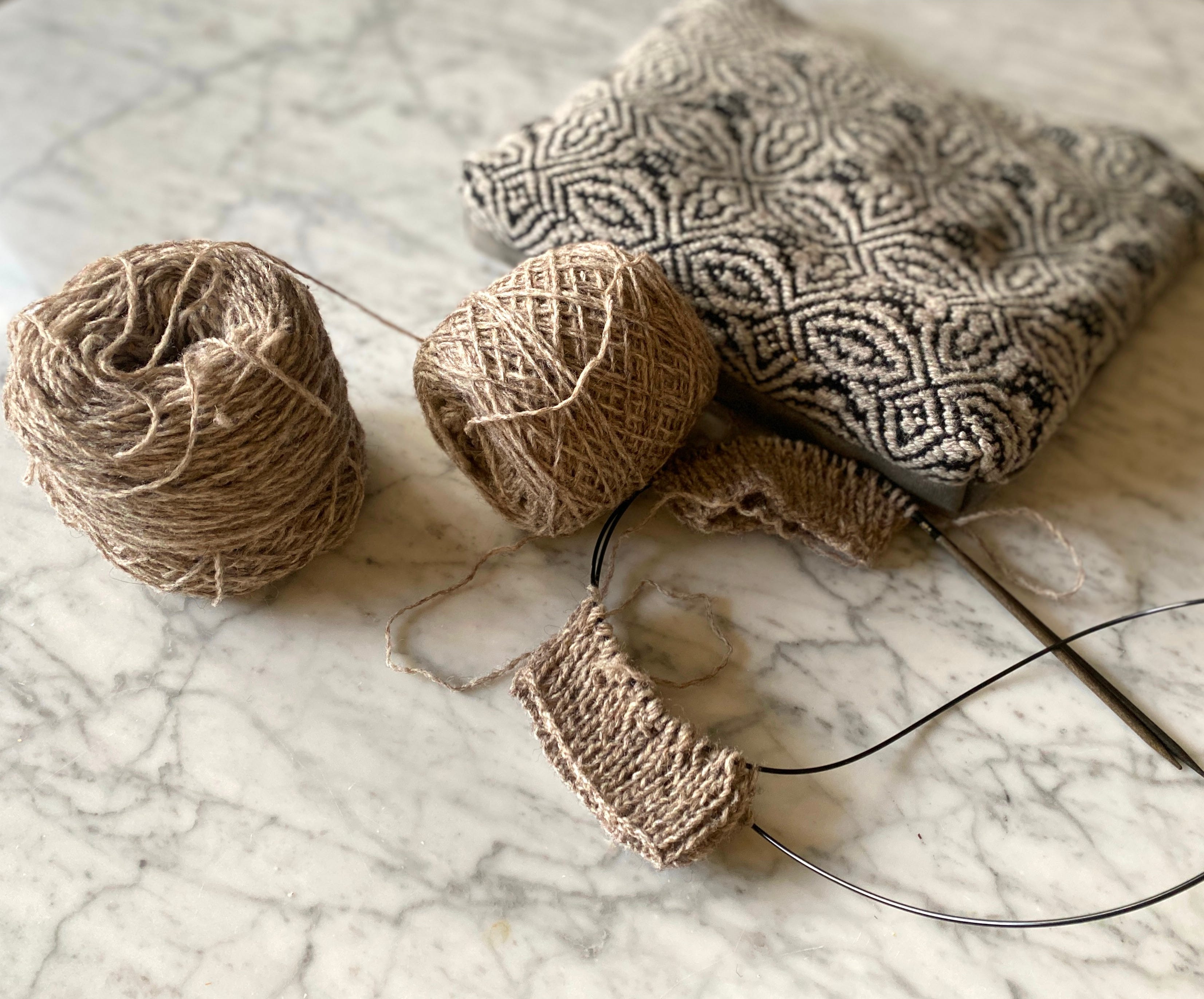
I’ve been knitting these half-gloves for months. It’s a form that I’ve made many times and I wanted to make them quickly so I thought I’d cast on two at a time. But my brain just didn’t want to hold the memory of how this works. I was already in an edge-space and I didn’t honour or pay attention to how run down and tired I was from all the hard work over the last couple of months. I thought I could just keep up the pace. And how hard is it to knit a pair of half-gloves? I kept making mistakes within the first few rounds and it felt like starting over was better than trying to repair the mistake. This forced slowness, the frustration, the reminder of my limitations and the awareness that I was once again in an edge-space was something I had to work through.
“There is a definite distinction between that marginality which is imposed by oppressive structures and that marginality one chooses as site of resistance, as location of radical openness and possibility.”
― bell hooks, Yearning: Race, Gender, and Cultural Politics
But what if I could just stay here, as I have before, being curious about this particular edge-space, discovering what it had to show me? What if I chose this edge-space? What might happen? What structures might I develop and lean on to scaffold me?
“Life is a good teacher and a good friend. Things are always in transition, if we could only realize it. Nothing ever sums itself up in the way that we like to dream about. The off-center, in-between state is an ideal situation, a situation in which we don’t get caught and we can open our hearts and minds beyond limit. It’s a very tender, non-aggressive, open ended state of affairs.”
— Pema Chodron, The Pocket Pema Chodron
In this season of year end reviews, lists and resolutions, I want to offer you something from the edge-space instead. An invitation to engage in fieldwork. Maybe this is a kind of syllabus for the listless, as in a person without lists who also lacks enthusiasm.
26-01 THRESHOLD FIELD: a syllabus for the listless.
Imagine a field without edges that acts as threshold, transition space, edge-space that sits between the known facts — day job, what to make for dinner, laundry that needs folding ... The field could be literal, unified or imaginary. It could be quantum or physical. It’s really just a holding space for your experiments. Draw the field, photograph a field, or find an image of a field if you need something to hold on to.
Within this field there is no resolution, just endless process. You don’t need to prepare anything to participate, you just need to be open to what comes up. Try anything you think of and place it within the field. Allow it to be influenced by the field and the other things you place there. It’s okay if this doesn’t make sense.
You will create your own method for orienting through experimentation without resolution. Maybe this looks like casting on a pair of half-gloves three times. Maybe it means walking around the block in circles until you get cold. Maybe you re-read a book that you didn’t like the first time to see if it’s redeemable. It could be a number of activities and it doesn’t need to cost anything. It can be simple. It should be a repetition if not entirely repeatable.
If you like, make a map of the field to help you orient. Place your experiments within it to see how they bump up against each other. Or if this feels too linear, find a different way to connect your field with the experiments.
The reason for bringing edge-space processes and fields together is to think about fieldwork in a broader sense and use it as a framework and a landscape and a way to orient. Fieldwork as a practice of hands-on research involving direct observation and data collection and fieldwork as a way to care for a place. What if we apply both to our edge-space? Would it develop edges?
Some things to support edge-space field work:
Sculpture in the Expanded Field by Rosalind Kraus via Shannon Mattern’s Library Field syllabus which also fits.
Sheila Hicks daily experiments.
Literal edge-spaces and their political consequences and simple beauty in the work of Tarik Kiswanson.
Orienting with somatic practices.
Artist Claudy Jongstra’s literal fieldwork.
The grid as expanded field in Howardena Pindell’s work.
A strange collection. My most-listened to artists in 2025: Kiasmos, Thievery Corporation, Brian Eno, Beatie Wolf, James, Wet Leg, Ariana Grande, Thelonious Monk, Max Richter, Ólafur Arnalds. Maybe there is something orienting for you here as well.
Any Dr. Who episode with doctors 10 through 12 or Star Trek: The Next Generation or Deep Space Nine episode. Think dinosaurs on a spaceship, fish and chips with custard, or Ode to Spot. Some research required here. Could be done while knitting.
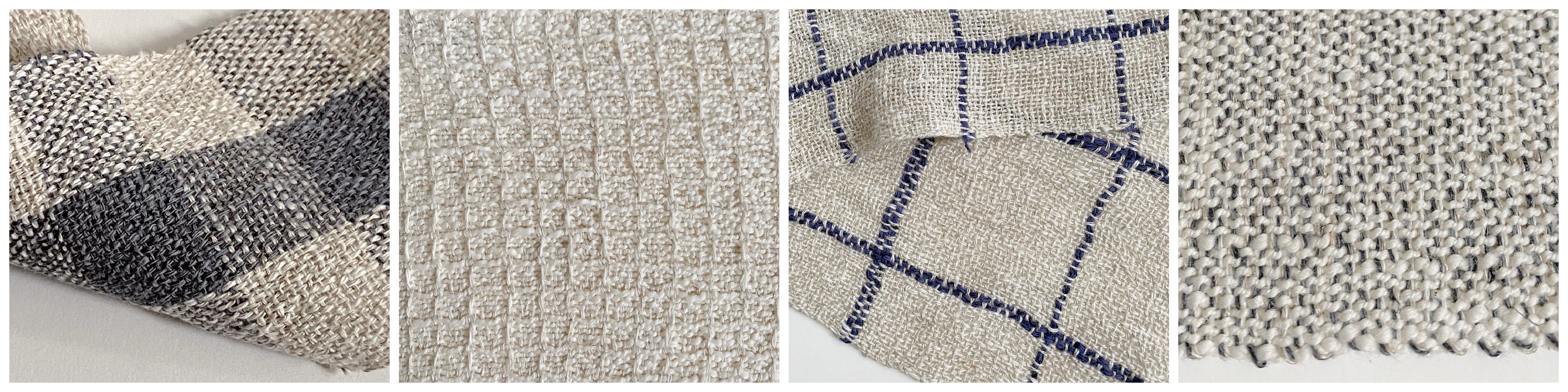
There are a couple of spots left in my new in person workshop series starting on January 10 — Soft Structures: Winter Wovens. Come weave with me! Make something both within and without a grid for your fieldwork.
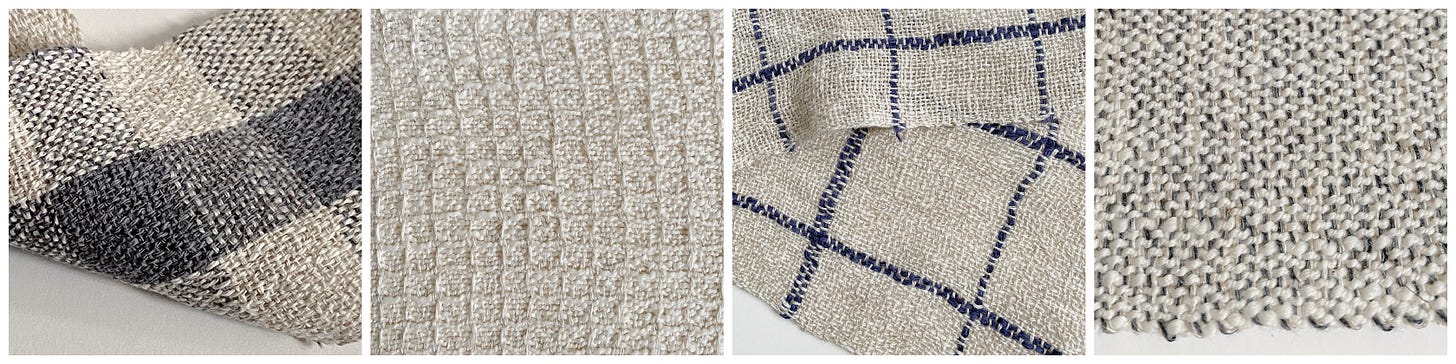
Samples from Forest Walk. We’ll do something similar. Each week we’ll build on skills learned the previous week to grow a collection of bespoke linens for the home.
until soon,
Amanda
I am feeling the edge-space.
I have been trying for months to read a book and I couldn’t. I realized I kept trying to reread old favourites and tried instead to read something new. I am reading Sara Imari Walker’s work now and it is working. She is a theoretical physicist working on the origin of life (a hard problem and an edge-space itself). She says we are in a “pre-paradigmatic” space, which comes before a big paradigm shift. Lex Fridman has an awesome interview with her where she is wearing bright yellow.
I keep seeing that we are moving from the year of the snake to the year of the horse. Learning and shedding in 2025 (It hasn’t been easy work.) Using what we’ve learned to move forward in 2026. I keep reading “momentum,” which isn’t really resonating with me. But horses have four legs. They’re heavy. I can walk slowly, let my hips sway, feel gravity and grounding. Maybe that’s enough to take me to the next place.
Thank you for these thoughts! I'm finding myself in a repetition, constantly correcting mistakes, disinterested in things I've invested in, but with no vision for what is next or where to go. Just a kind of weird waiting. It was comforting to see how it could be reframed.